Who among you works honestly all the hours you are supposed to, without indulging in distractions, giving to it all your energy, knowledge and patience? This applies especially to those who work for a flat wage. We get paid in full regardless of whether we put in an honest day's work or not. If we use time at work for other things, the money we receive is yet another example of dishonest gain.
We do not consider this a sin, even though we are in fact deceiving the government, stealing time and money from society. Perhaps some of you might think, "Well, almost everyone acts that way; it's a rare individual who is a real worker." But Christians, by their calling, are supposed to be especially honest and conscientious workers, to do every job as if it were assigned by the Lord Himself, who observes with what zeal, honesty and conscientiousness we work.
We read in the Morning Prayers: ". . . by Thy loving-kindness I strive to do Thy works." What are these works of the Lord? All those tasks which we undertake at home for the family or at work, or obediences, in the case of monastics, tasks which are ours to do-these are those "works" that the Lord has entrusted us with at the present time, and we will answer first of all to Him whether we have performed our duties honestly and conscientiously. Many of us don't think about this. We work any which-way, just trying to make the time go by faster, to get more money, to work less and with less effort
Archimandrite Ioann Krestiankin
July 09, 2010
July 08, 2010
Our life is children's play...
Our life is children's play, only not innocent, but sinful, because, with a strong mind, and with the knowledge of the purpose of our life, we neglect this purpose and occupy ourselves with frivolous, purposeless matters. And thus our life is childish, unpardonable play. We amuse ourselves with food and drink, gratifying ourselves by them, instead of only using them for the necessary nourishment of our body and the support of our bodily life. We amuse ourselves with dress, instead of only decently covering our body and protecting it from the injurious action of the elements. We amuse ourselves with silver and gold, admiring them in treasuries, or using them for objects of luxury and pleasure, instead of using them only for our real needs, and sharing our superfluity with those in want. We amuse ourselves with our houses and the variety of furniture in them, decorating them richly and exquisitely, instead of merely having a secure and decent roof to protect us from the injurious action of the elements, and things necessary and suitable for domestic use. We amuse ourselves with our mental gifts, with our intellect, imagination, using them only to serve sin and the vanity of this world—that is, only to serve earthly and corruptible things—instead of using them before all and above all to serve God, to learn to know Him, the all-wise Creator of every creature, for prayer, supplication, petitions, thanksgiving and praise to Him, and to show mutual love and respect, and only partly to serve this world, which will some day entirely pass away. We amuse ourselves with our knowledge of worldly vanity, and to acquire this knowledge we waste most precious time, which was given to us for our preparation for eternity. We frequently amuse ourselves with our affairs and business, with our duties, fulfilling them heedlessly, carelessly, and wrongfully, and using them for our own covetous, earthly purposes. We amuse ourselves with beautiful human faces, or the fair, weaker sex, and often use them for the sport of our passions. We amuse ourselves with time, which ought to be wisely utilised for redeeming eternity, and not for games and various pleasures. Finally, we amuse ourselves with our own selves, making idols out of ourselves, before which we bow down, and before which we expect others to bow down. Who can sufficiently describe and deplore our accursedness, our great, enormous vanity, the great misery into which we voluntarily throw ourselves? What answer shall we give to our immortal King, Christ our God, Who shall come again in the glory of His Father to judge both the quick and the dead, to declare the secret thoughts of all hearts, and receive from us our answer for every word and deed. O, woe, woe, woe to us who bear the name of Christ, but have none of the spirit of Christ in us; who bear the name of Christ, but do not follow the teaching of the Gospel! Woe to us who "neglect so great salvation"!(Hebrews ii. 3). Woe to us who love the present fleeting, deceptive life, and neglect the inheritance of the life that follows after the death of our corruptible body beyond this carnal veil!
From My Life in Christ
by St. John of Krondstadt
From My Life in Christ
July 07, 2010
We are an "Old Calendar" Church
By Fr. Alexander Lebedeff
In my honest opinion, world Orthodoxy is now experiencing a polarization into two camps: for lack of a better term one can think of them as " traditionalists" and "modernists."
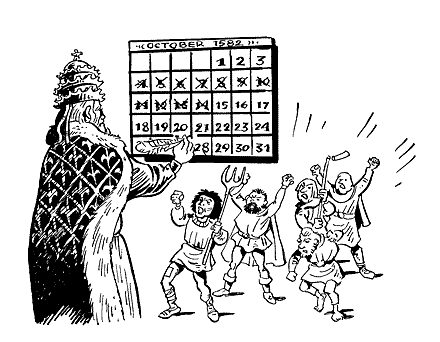
As we all know, the 19th century saw the development of liberal ideas that ultimately led to the revolution in Russia. A number of the clergy in the Russian Orthodox church had become involved in the liberal movement and wished to "liberalize" the Church. Their proposals included: a change to the New Calendar (the Gregorian Calendar, introduced by Pope Gregory XIII at the end of the 16th century and rejected by all the Orthodox churches at that time, who continued to use the traditional Julian Calendar); married bishops; permission for priests to marry a second time; shortening of services; reduction of fasting periods and the strictness of the fasts; use of non-clerical garb by clergy outside of the church; eliminating the traditional requirement of beards and long hair for clergy; and many other innovations.
These priests became the kernel of the so-called "renovationist" movement in early post-revolutionary Soviet Russia, which cooperated with them, since they expressed complete support for the Communist regime. Most of the church buildings in the Soviet Union were transferred to the renovationists, andthose who didn't cooperate (the followers of Patriarch Tikhon) were persecuted and often killed.
At the same time, a rather interesting figure had had himself elected to the office of Patriarch of Constantinople, Meletios Metaxakis. This individual had previously been Archbishop of Athens, then Patriarch of Alexandria. It is not exactly clear how he had been able to be the head of three independent local Orthodox Churches in succession. Suffice it to say, it is known that he was a Freemason and had "connections."
He was extremely modernist in his views. He supported all of the above-mentioned innovations of the renovationists, and shocked the Orthodox world by appearing in a civilian suit. In 1923 he instituted an official change to the new calendar, although the other innovations he proposed did not go through. He also recognized the Renovationists in Soviet Russia as the true Church of Russia and joined in their condemnation and deposition of Patriarch Tikhon.
To make a long story short, as a result of the calendar innovation, the Orthodox world was divided. Some of the Orthodox churches remained Old Calendar, some accepted the New, and the liturgical unity of the Church was shattered. In Greece, the introduction of the new calendar caused extraordinary upheaval and physical persecution of the old-calendarists was widespread.
The calendar question is one of extraordinary significance to "traditionalist" Orthodox, although it is presented as a matter of little importance by the new-calendarists ("This is not an issue of dogma, Father, just custom," one hears). The answer, of course, is that the Pope's calendar innovation had been condemned many times by pan-Orthodox Councils, so it is not a matter of "taste."
So how has this affected Orthodoxy in the United States? Today one can see the following: New-calendar churches, typically, have accepted many of the "trappings" of Roman Catholic and Protestant churches. They, for the most part, have pews in their churches, some have organs (!) and electronic carillons instead of bells, their priests, and in some cases even bishops, most often wear "clerical collars" and suits (outside of the services), almost all clergy have short hair and trimmed or no beards, and like to be called "Father Tom," or "Father Al." The services are typically shortened, frequently even Saturday-night Vigil services are eliminated. The new-calendarists have relatively few monasteries and monastic clergy. Many churches thrive on Bingo, and almost all have lay "presidents" of the congregation, who, together with a parish council, direct the affairs of the church. Being a Freemason is not considered to be in conflict with Orthodoxy.
On the other hand, traditionalist Orthodox parishes will never have pews, organs and the like; their clergy will never be seen without a rasson (they wouldn't be caught dead wearing a "dog collar" and "clergy shirt"!); no one would dream of addressing them as "Father Tom"; they typically do not cut their hair or beards (unless required by outside employment); the services follow a much fuller Typicon; the priests are rectors of their parishes and they are themselves the "presidents" of the parish corporations, with the parish council acting in a more advisory role; there are far more monastic clergy and many monasteries and convents. Freemasonry is soundly condemned as incompatible with Orthodoxy.
Another significant area dividing traditional Orthodox from their "modernist" brethren is the area of Ecumenism. To a traditionalist Orthodox,ecumenism is an outright heresy, condemned by innumerable Councils who clearly forbid praying with heretics.
The new-calendarists, on the other hand, are very active participants in the "ecumenical movement," in the WCC and the NCC, notwithstanding the incredible mixture of paganism, new-world thinking, radical feminism, and other weird stuff that goes on at WCC assemblies.
Unfortunately, the last three Patriarchs of Constantinople (Athenagoras, Demetrius, and, now, Bartholemew, have been rabid ecumenists. Patriarch Bartholemew, at least at the time he was Metropolitan) had frequently been photographed in a civilian business suit (with tie, not even an ecclesiastical collar), and studied at the Papal Institute in Rome. He recent meetings with the Pope underscore his desire to reunite with Rome by the year 2000. He, and other ecumenically-oriented Eastern Patriarchs have virtually accepted the Monophysite heretics as valid Orthodox, without making them renounce their views or accept the Orthodox position regarding the Divine and human natures of Christ.
All this is appalling to traditionalist Orthodox, who wish to preserve the faith of the Apostles and the Fathers without any change.
As a Roman Catholic, some of this may be familiar to you. You may remember the upheaval that was caused in the RC church when wholesale modernization took place.
The traditional Orthodox will struggle to keep this from happening within Orthodoxy. Although a relatively small part of the contemporary Orthodox population, the traditionalists (comprising the Russian Orthodox Church Outside of Russia, which has 400 clergy outside of Russia; the old calendarist churches of Greece, Bulgaria, Roumania, and like-minded Orthodox throughout the world) will continue to witness for the purity of Orthodoxy and against the heresies of modernism and ecumenism that have, so unfortunately, infected so much of World Orthodoxy.
While there are some fanatical fringe groups within the traditionalist movement (who aver that everyone else is devoid of grace), the majority of traditionalists do not agree. They consider the other (modernist) Orthodox to still be Orthodox, although in grave error, and pray for their return to the path of traditional Orthodoxy, as preserved by the Church for 2000 years. Among the "modernists" there is also a fanatic fringe, who consider the traditionalist Orthodox to be "schismatics" and outside the Church.
I think we should let the two fanatic fringes shout themselves out, while the more rationally-minded traditionalist and new-calendar Orthodox Christians should engage in peaceful and constructive dialogue in non-confrontational places such as this forum, and of course, pray for each other as brothers and sisters in Christ.
- What is the distinction between Old and New Calendars?
- Why is the division so prominent?
In my honest opinion, world Orthodoxy is now experiencing a polarization into two camps: for lack of a better term one can think of them as " traditionalists" and "modernists."
As we all know, the 19th century saw the development of liberal ideas that ultimately led to the revolution in Russia. A number of the clergy in the Russian Orthodox church had become involved in the liberal movement and wished to "liberalize" the Church. Their proposals included: a change to the New Calendar (the Gregorian Calendar, introduced by Pope Gregory XIII at the end of the 16th century and rejected by all the Orthodox churches at that time, who continued to use the traditional Julian Calendar); married bishops; permission for priests to marry a second time; shortening of services; reduction of fasting periods and the strictness of the fasts; use of non-clerical garb by clergy outside of the church; eliminating the traditional requirement of beards and long hair for clergy; and many other innovations.
These priests became the kernel of the so-called "renovationist" movement in early post-revolutionary Soviet Russia, which cooperated with them, since they expressed complete support for the Communist regime. Most of the church buildings in the Soviet Union were transferred to the renovationists, andthose who didn't cooperate (the followers of Patriarch Tikhon) were persecuted and often killed.
At the same time, a rather interesting figure had had himself elected to the office of Patriarch of Constantinople, Meletios Metaxakis. This individual had previously been Archbishop of Athens, then Patriarch of Alexandria. It is not exactly clear how he had been able to be the head of three independent local Orthodox Churches in succession. Suffice it to say, it is known that he was a Freemason and had "connections."
He was extremely modernist in his views. He supported all of the above-mentioned innovations of the renovationists, and shocked the Orthodox world by appearing in a civilian suit. In 1923 he instituted an official change to the new calendar, although the other innovations he proposed did not go through. He also recognized the Renovationists in Soviet Russia as the true Church of Russia and joined in their condemnation and deposition of Patriarch Tikhon.
To make a long story short, as a result of the calendar innovation, the Orthodox world was divided. Some of the Orthodox churches remained Old Calendar, some accepted the New, and the liturgical unity of the Church was shattered. In Greece, the introduction of the new calendar caused extraordinary upheaval and physical persecution of the old-calendarists was widespread.
The calendar question is one of extraordinary significance to "traditionalist" Orthodox, although it is presented as a matter of little importance by the new-calendarists ("This is not an issue of dogma, Father, just custom," one hears). The answer, of course, is that the Pope's calendar innovation had been condemned many times by pan-Orthodox Councils, so it is not a matter of "taste."
So how has this affected Orthodoxy in the United States? Today one can see the following: New-calendar churches, typically, have accepted many of the "trappings" of Roman Catholic and Protestant churches. They, for the most part, have pews in their churches, some have organs (!) and electronic carillons instead of bells, their priests, and in some cases even bishops, most often wear "clerical collars" and suits (outside of the services), almost all clergy have short hair and trimmed or no beards, and like to be called "Father Tom," or "Father Al." The services are typically shortened, frequently even Saturday-night Vigil services are eliminated. The new-calendarists have relatively few monasteries and monastic clergy. Many churches thrive on Bingo, and almost all have lay "presidents" of the congregation, who, together with a parish council, direct the affairs of the church. Being a Freemason is not considered to be in conflict with Orthodoxy.
On the other hand, traditionalist Orthodox parishes will never have pews, organs and the like; their clergy will never be seen without a rasson (they wouldn't be caught dead wearing a "dog collar" and "clergy shirt"!); no one would dream of addressing them as "Father Tom"; they typically do not cut their hair or beards (unless required by outside employment); the services follow a much fuller Typicon; the priests are rectors of their parishes and they are themselves the "presidents" of the parish corporations, with the parish council acting in a more advisory role; there are far more monastic clergy and many monasteries and convents. Freemasonry is soundly condemned as incompatible with Orthodoxy.
Another significant area dividing traditional Orthodox from their "modernist" brethren is the area of Ecumenism. To a traditionalist Orthodox,ecumenism is an outright heresy, condemned by innumerable Councils who clearly forbid praying with heretics.
The new-calendarists, on the other hand, are very active participants in the "ecumenical movement," in the WCC and the NCC, notwithstanding the incredible mixture of paganism, new-world thinking, radical feminism, and other weird stuff that goes on at WCC assemblies.
Unfortunately, the last three Patriarchs of Constantinople (Athenagoras, Demetrius, and, now, Bartholemew, have been rabid ecumenists. Patriarch Bartholemew, at least at the time he was Metropolitan) had frequently been photographed in a civilian business suit (with tie, not even an ecclesiastical collar), and studied at the Papal Institute in Rome. He recent meetings with the Pope underscore his desire to reunite with Rome by the year 2000. He, and other ecumenically-oriented Eastern Patriarchs have virtually accepted the Monophysite heretics as valid Orthodox, without making them renounce their views or accept the Orthodox position regarding the Divine and human natures of Christ.
All this is appalling to traditionalist Orthodox, who wish to preserve the faith of the Apostles and the Fathers without any change.
As a Roman Catholic, some of this may be familiar to you. You may remember the upheaval that was caused in the RC church when wholesale modernization took place.
The traditional Orthodox will struggle to keep this from happening within Orthodoxy. Although a relatively small part of the contemporary Orthodox population, the traditionalists (comprising the Russian Orthodox Church Outside of Russia, which has 400 clergy outside of Russia; the old calendarist churches of Greece, Bulgaria, Roumania, and like-minded Orthodox throughout the world) will continue to witness for the purity of Orthodoxy and against the heresies of modernism and ecumenism that have, so unfortunately, infected so much of World Orthodoxy.
While there are some fanatical fringe groups within the traditionalist movement (who aver that everyone else is devoid of grace), the majority of traditionalists do not agree. They consider the other (modernist) Orthodox to still be Orthodox, although in grave error, and pray for their return to the path of traditional Orthodoxy, as preserved by the Church for 2000 years. Among the "modernists" there is also a fanatic fringe, who consider the traditionalist Orthodox to be "schismatics" and outside the Church.
I think we should let the two fanatic fringes shout themselves out, while the more rationally-minded traditionalist and new-calendar Orthodox Christians should engage in peaceful and constructive dialogue in non-confrontational places such as this forum, and of course, pray for each other as brothers and sisters in Christ.
July 06, 2010
The Challenge of Raising Children in the 21st Century
| By Fr. Alexis Miller | |
In the Orthodox Church we often use the expression that the home should be like "a little church." In Romania, a country the size of the state of Pennsylvania with over 500 monasteries, they take this saying a step further and say that the home should be like "a little monastery." It is my firm belief that in our increasingly secular and hedonistic culture, these sayings are true more now than ever. To raise Christian children in 21st century America, parents need all the help they can get from the church and, yes, even the monasteries.
As a parent of four children and as a youth worker in the secular arena, I have a great deal of experience working with kids. I've seen the successful results of raising kids according to God's laws and wisdom, and I've seen the damage done when parents don't draw from the rich resources of our Judeo-Christian heritage. I teach a parenting class in my vocation as a certified prevention professional and I always tell the parents, "You have to be militant against our culture to be successful at raising kids these days." Unfortunately most of these parents are outside the church and do not have the weapons they need to engage in this cultural battle. In fact, many of them are themselves caught up in the very cultural influences that are causing their kids to get involved in alcohol, tobacco, and other drugs, criminal behavior, sexual promiscuity, and poor school performance.
In this article I will share some suggestions for ways that we as Orthodox Christians can raise children who will be able to withstand the anti-Christian forces at work in our culture. If some of these suggestions hit too close to home, please forgive me. It is not my intention to condemn anyone or make anyone feel guilty if they have failures in the area of parenting and family relations. My hope is to give guidance to those who are in the midst of the challenge of raising and preserving Christian families in an antagonistic culture.
I'll start with some basics: Christian parents need to have good solid marriages. They need to be "grown up" in the sense that they know who they are, they are solid in their commitment to their spouses, and they are firmly planted in the church. Many of the parents I work with are too busy going through their own personal soap operas to have the time or emotional energy to give their kids the guidance and protection that kids need.
If you have been married in the Orthodox Church and have kids, you don't get to be an adolescent. You can't be wondering if you married the right person or be busy trying to turn your spouse into "the right person." The grace of the sacrament of marriage has been given to you and the righteous response is to put your hand to the plow and never look back. If your spouse can't make you happy, remember: we are put on this earth to be holy, not happy.
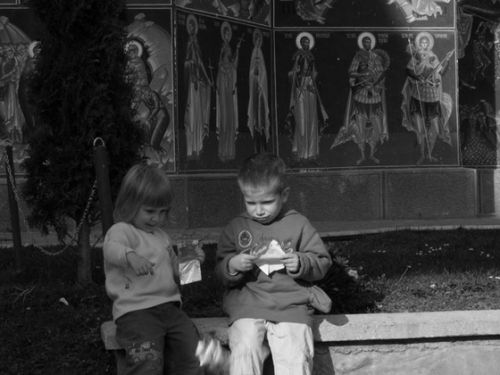
![]() |
| Photo: www.orthphoto.net |
With a good marriage and a life centered in the local Orthodox Christian parish, Orthodox parents must set about the task of parenting with vigilance and intensity. Here are some practical suggestions:
1) Every child should go to bed at night with a Bible story being read to them by one of the parents. A good Bible story book will take a child completely through the major stories, themes, and lessons of the Old and New Testament in a relatively short period of time. With my own children I have used the same book over and over for the last 23 years. When I get to the end of it, I simply start over at the beginning. Each time they hear the stories they have grown a couple inches and gained more maturity and the stories are understood at a deeper level.
2) Families need to pray together. Christ the Savior Seminary has a wonderful little book of mealtime prayers that we have used in our home for years. Each week we sing the prayers in the vesperal tone of the week. What a joy to sing the Plain Chant in our home and practice for the stichera to be sung at Great Vespers on Saturday night. Families should also try to gather at least once a day for prayers at the family icon corner. This is one of the key ways that children perceive their home to be a "little church." This also helps them to realize that worship is not a once a week go to church type thing but is rather at the heart of who we are and what we do in this life.
3) The "little church" needs to be centered in the "big church." Attendance at Divine Liturgy, Vespers, and other services should not be optional for children. Children need to grow up knowing that this is simply what Orthodox Christians do, that the divine services are the most important, life-giving and, special events of the week. A rich liturgical life in both the small church and the big church will go along way in helping our children to grow up as worshippers of the One True God, the Holy Trinity.
4) After your spouse, your children need to be the most important people in your lives. Next to a strong marriage, your children's health and holiness need to be your highest priority as a family. Personal interests and hobbies that conflict with this priority need to be put on hold until the kids are raised. The more we invest in our children, the more they will identify with our values and take the course we have set for them. "Train up a child in the way he should go, when he is old he will not depart from it."
In addition to all of these positive suggestions, I have a list of things from which Christian parents need to protect their children. There are many things in our culture that may not appear to be intrinsically evil but in reality war against our children and hinder them in living a holy Christian life. It is in regards to these things that the Romanian reference to the "little monastery" becomes particularly relevant.
1 Video games. Video games of almost any type are a great hindrance to the development of Christian virtues. Even educational types of games can be harmful in that they can create an over-dependence on entertainment, visual and audio stimulation, and immediate gratification. Many video games are overtly anti-Christian, promoting violence, selfishness, lust, criminal behavior and pleasure seeking of all kinds. In addition, they create hyperactivity, impatience, nervousness, and the need to be constantly entertained and stimulated. In no way do these games help the child to live a life of meditation upon God, quietness, patience, hard work, and living for others.
2. Television, music, internet, magazines and other forms of secular information media. Parents should strictly regulate what kinds of materials their children are exposed to, just as the abbot of a monastery gives his blessing for the monks to do their various tasks and activities. It is a grave error to allow children free reign on these types of materials. Everything should be scrutinized under the lens of the Holy Scriptures, the Church Fathers, and the whole Tradition of the church. Any form of entertainment or information which does not lift up and edify the human person as created in the image of God, should be avoided and prohibited.
3. Tolerance of sexual impurity and promiscuity. Our popular secular culture is at war against our children to take away their innocence and virginity. Orthodox Christian parents need to talk to their children about sexual issues as soon as they are old enough to comprehend the subject. They should be taught that virginity is the highest prize of their childhood and the greatest gift they can give to their future spouse.
Parents need to set "old-fashioned" parameters for their children in terms of dating and how they relate to the opposite sex. The lives of the monastic and married saints should be lifted up as examples of marital fidelity, chastity and purity. Children should be exposed to the monastic life of the church and be allowed to consider monasticism as a life choice.
Orthodox parents should not assume their children will be able to keep their virginity in this culture which is so aggressively pushing them to be sexually active. We need to be aggressive and militant in promoting sexual purity to our children and often this will mean saying no to them. This means saying no to t-shirts that expose the belly-button, low hanging jeans that expose the waist line, and other articles of clothing bent on exposing more and more of the human body. The American fashion industry is set on making teen age girls look as sexy as possible. This is in no way compatible with Orthodox Christianity.
4. Alcohol, tobacco, and other drugs. These substances pose a great threat to the spiritual and physical health of our children. In fact, the use of tobacco is a primary predictor of a child who is at risk of poor school performance, sexual promiscuity, criminal activity, and other risky behaviors. Parents need to have an open line with their kids about these substances from the earliest years and kids need to have a clear message of disapproval from their parents concerning the use of any mind-altering substance including tobacco.
In conclusion, Orthodox Christian parents cannot afford to be wimps. We need to take the authority of an abbot in our little monasteries, providing our children with spiritual formation bathed in the tradition of the church. This requires courage and mental fortitude, being able to withstand our children's anger at times, and determination to stand against the current tide. Christian parenting in the 21st century is like swimming upstream in a swollen river. The good news is that if we stay firmly anchored to the arc of the Church we and our children will not be swept away in the rushing waters of a nation that has forgotten God. We have in the church every resource we need to raise holy and healthy children who will be able to keep their virginity, stay free from drug addiction, and reach their full potential as human beings created in the image of the One God in Three Persons, the Holy Trinity, Father Son and Holy Spirit.
July 05, 2010
Behold, Thy Mother
The greatest desire of every Christian should be to draw nearer to our Lord, God and Saviour, Jesus Christ. Many are the means provided for us to do so; among them are the sacraments, the Holy Gospel, and prayer. A special means of drawing closer to Christ is through devotion to His most pure Mother, the Ever-Virgin Mary. Our Lord dwelt in her as a babe in her womb. He was always with her, either by His physical presence, as when He lived with her in Nazareth, or spiritually, in her constant prayerful communion with God. This union was not broken by death, and she now occupies a particular place of closeness to her Son in heaven. It was through Mary that God chose to come to mankind. He made her cooperation the condition for His appearance on earth. Since our Lord came to us through Mary, it is fitting that we come to Him through her. To this end He made her our mother also. At the very moment of His supreme sacrifice, as He was dying upon the Cross for our salvation, He said to His beloved disciple, Saint John, Behold thy mother, and to His Mother, Behold thy son (John 19:26-27), thus signifying that His Mother was to be the spiritual mother of all Christians, who, in the person of Saint John, became her children.
Our Orthodox affirmation that Mary is the Mother of God (Theotokos) confesses our belief in Jesus Christ as God. All Orthodox devotion to Mary is founded upon this principle. In Orthodox iconography, Mary is almost always represented together with her Son. She is a means, a way to the goal, which is Christ. True devotion to the Mother of God brings us unfailingly to her Son Jesus Christ, our Saviour and God.
Protestants often reproach us for our veneration of the Mother of God. They say it is unscriptural, and that Christ is our sole Mediator with the Father. It's hue, in the Bible there is little about Mary. But after all, the New Testament is primarily the story of Christ, His life and teachings, and the story of His Church, as told by His Apostles. It would have been characteristic of the most pure Virgin not to seek a prominent place in the telling of that story, preferring, in her supreme humility, to remain in the background. Then again, had the Apostles written much about the greatness and glories of Mary, it might have seemed to the pagan world in which they lived that she was some sort of goddess to be worshipped, on account of her closeness to God. Much more about Mary entered the unwritten tradition of the Church, and was passed on by word of mouth for years before it was finally recorded in works of the Holy Fathers. And yet, for those with "eyes to see", the Holy Virgin is very much present in Scripture. In the Old Testament the Church sees her prefigured under many images and symbols, such as the burning bush and Jacob’s ladder. And in the New Testament she figures in the most important events surrounding the economy of our salvation: the Incarnation and Nativity of Christ, His redeeming Death on the Cross, the Descent of the Holy Spirit – when she was together with the Apostles at prayer in the upper room. It was at her behest that our Lord performed His first miracle – turning water into wine at the marriage feast in Cana. Without exaggeration one can say that she inaugurated the New Testament, when she heard the greeting of the archangel: "Rejoice, full of grace" and made the leap of faith and said "yes" to God, agreeing to bring His Son into the world as its Redeemer.
The poor Protestants who do not know the Mother of God are like motherless orphans. But what are we if, having such a mother, we neglect her? Orphans inspire pity, but children who neglect their mother are worthy of contempt. If we live in the spirit of the Church, we shall never neglect our mother, the Mother of God. There is not a single service of our Church that fails to invoke her name; the liturgical year is adorned with her feasts; no Orthodox church or home is without an icon of her. The prayer, "Virgin Mother of God, rejoice..." is part of our daily rule. Our whole prayer life echoes with the oft-repeated cry, "Most holy Mother of God, save us." [Note]
While careful not to fall into the excesses of Roman theology, we can never say enough about the Mother of God. As one hymn puts it, "Every tongue is at a loss to praise thee as is due: even a spirit from the world above is filled with dizziness, when it seeks to sing thy praises, O Theotokos" (Irmos, Ninth canticle of Matins for the feast of Theophany). However, all that we say and sing concerning the Mother of God will remain pretty poetry and sweet sentiment if we do not give her a real role in our lives. We should speak to her as to our mother, with honor and love, trusting in her maternal care and affection. If we make her a part of our lives, we shall always be striving to imitate her virtues. And when we fall short, as we so often do, we can run to her for forgiveness, knowing that she is the "Surety of sinners" and their "Unexpected Joy", reconciling us with God. We can always bring our troubles and sorrows to the Mother of God, because she who suffered so intensely together with Her Divine Son in His Passion is well able to understand our sufferings. She can give us the strength to bear our afflictions; as the "Joy of all who sorrow" she can "Assuage our sorrows."
Today, as we struggle against the imposition of a culture where everything is tolerated but the pure truth of Jesus Christ, we desperately need the spiritual support which the Mother of God offers to those who honor her. For Orthodox Christians she is an "invincible rampart" of spiritual life, "ever watchful in her prayers." Among human beings she is the summit of perfection. Her entire life was spent in conformity with the will of God. She, better than anyone who has ever lived, was blessed in hearing the word of God and keeping it. The more we come to know the Mother of God and appreciate her role in the whole scheme of our salvation, the more reason we will find to give thanks to God for bestowing her upon us as our mother.
Hieromonk German Ciuba
Subscribe to:
Posts (Atom)